Additional information
| Dimensions (H) | 11 inches |
|---|---|
| Dimensions (W) | 8.5 inches |
| Other Materials Needed | Fundamentals of the Sentence Writing Strategy: Student Materials |
| Publisher | Edge Enterprises, Inc. |
| Year Printed | 2026 |
| Page Count | 114 |

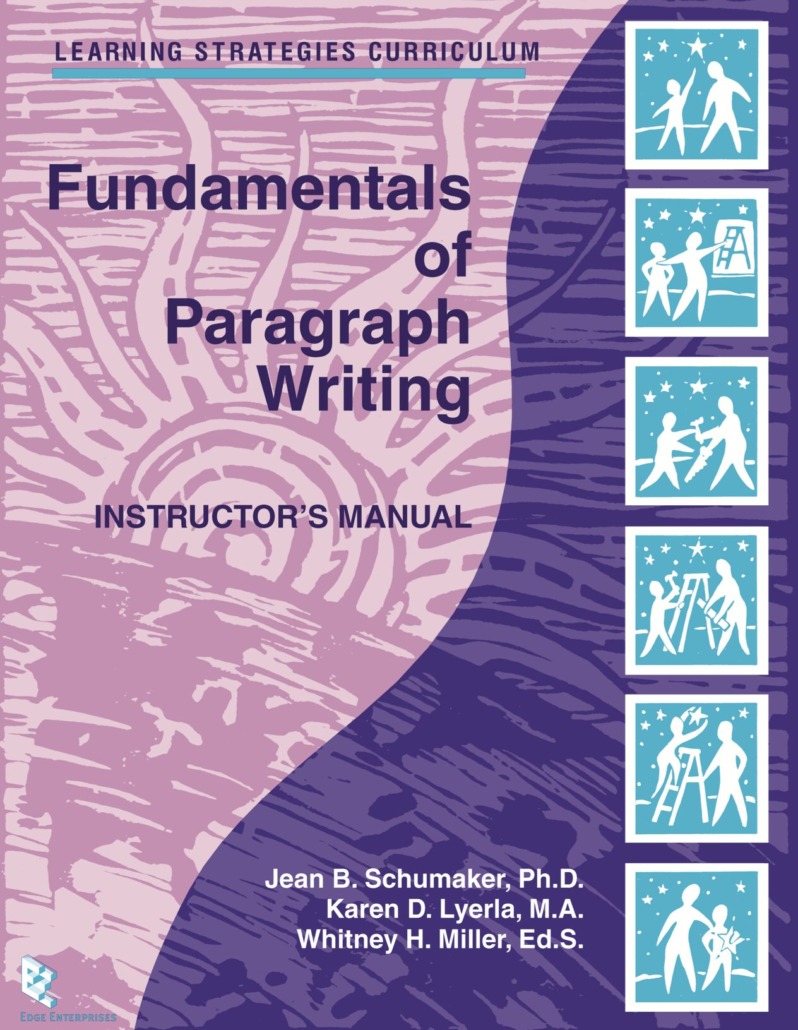
This instructional program was designed for and field tested with students in grades 2 through 6. It can be used in general and special education classes. The instructor’s manual covers instruction in all the basic components of a paragraph, including verb tense, point of view, transitions, Topic Sentences, Detail Sentences, and Clincher Sentences. It also covers three fundamental types of paragraphs, including Descriptive, Narrative, and Persuasive (Reasons) Paragraphs. Each of these concepts is covered using the lesson format, with one lesson per concept. The analogy of a hamburger is used to explain how a paragraph is to be built by a student.
Accompanying the instructor’s manual is an online website that contains close to 300 instructional resources. These items include cue cards, notes sheets, learning sheets, score sheets, progress charts, management charts, PowerPoint shows, and teacher-designed documents that can be used to support instruction. These materials correspond to the lessons in the instructor’s manual. They can be copied and used as needed for instructing students in the program.
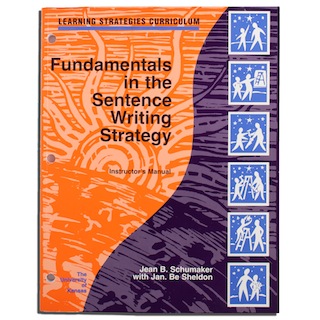
Instruction in the Fundamentals in the Sentence Writing Strategy program (Instructor’s Manual and Student Materials linked here) is highly recommended before using this program. Students need to be able to write and check complete sentences before beginning this program.
$20.00
| Dimensions (H) | 11 inches |
|---|---|
| Dimensions (W) | 8.5 inches |
| Other Materials Needed | Fundamentals of the Sentence Writing Strategy: Student Materials |
| Publisher | Edge Enterprises, Inc. |
| Year Printed | 2026 |
| Page Count | 114 |
The Fundamentals of Paragraph Writing program was field tested in two 6th grade classrooms. These were inclusive classes in which some students with disabilities were enrolled. Thirty-three students took both the pretest and posttest. Seven of them had been given a diagnosis requiring special education services. All of the students took the pretest before they began instruction in Fundamentals in the Sentence Writing Strategy program. They took the posttest after they participated in that sentence-writing instruction plus instruction in the Fundamentals of Paragraph Writing. For the pretest and posttest, they were asked to write a paragraph containing eight sentences in response to a prompt. A different prompt was given for the pretest versus the posttest.
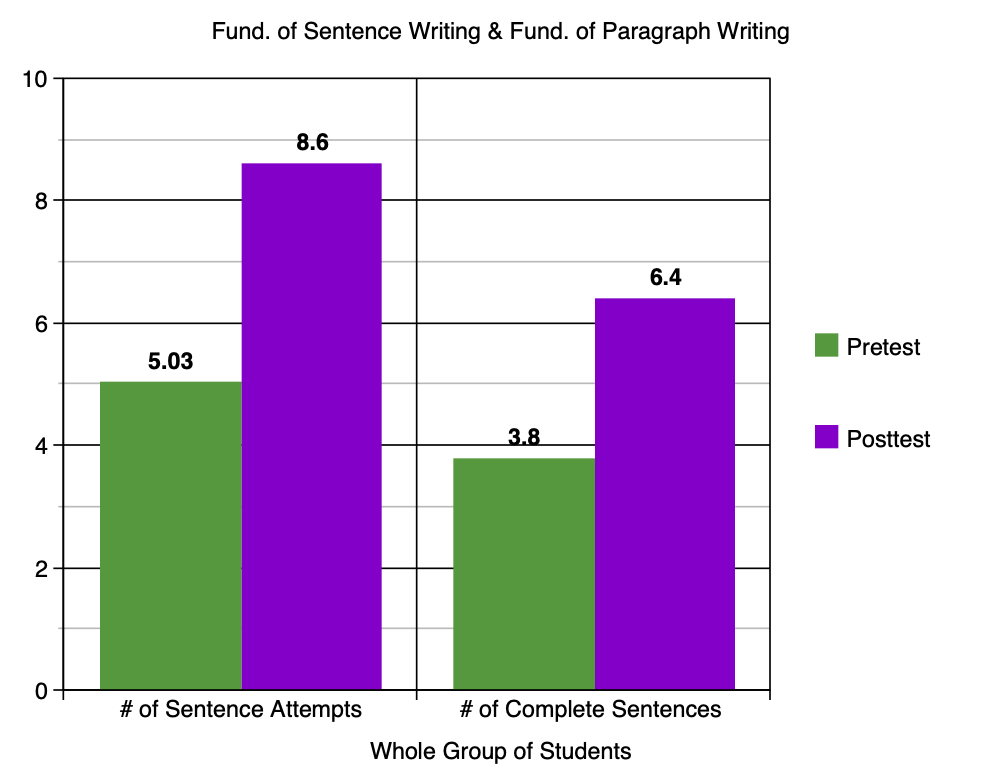
During the pretest, the whole group of students wrote an average of 3.8 complete sentences. During the posttest, they wrote an average of 6.4 complete sentences. During the pretest, they attempted an average of 5.03 sentences. During the posttest, they attempted an average of 8.6 sentences. Thus, the number of sentences they attempted to write and the number of complete sentences increased.
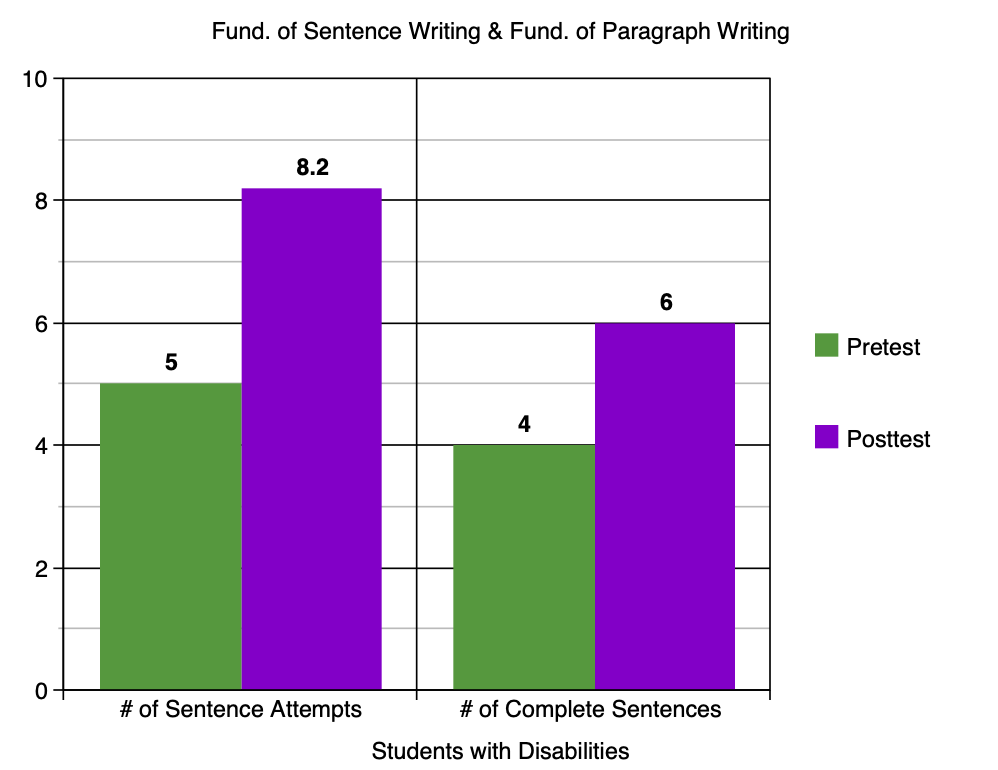
The results for the students with disabilities also represented gains. They wrote an average of 4 complete sentences during the pretest and an average of 6 complete sentences during the posttest. They attempted an average of 5 sentences on the pretest and 8.2 sentences on the posttest. Thus, all the students were attempting to write more sentences, and more of their attempted sentences were complete.
With regard to paragraph organization, the whole group of students earned an average of 19 points on the pretest and 32 points on the posttest out of a total of 50 points. On the pretests, their scores ranged from 4 points to 38 points. On the posttests, their scores ranged from 18 to 50 points out of 50 points. The students with disabilities had similar results. They earned an average of 19 points for paragraph organization on the pretest and an average of 33 points on the posttest. Their pretest scores ranged from 12 to 26 points, and their posttest scores ranged from 18 to 50 points out of 50 points.
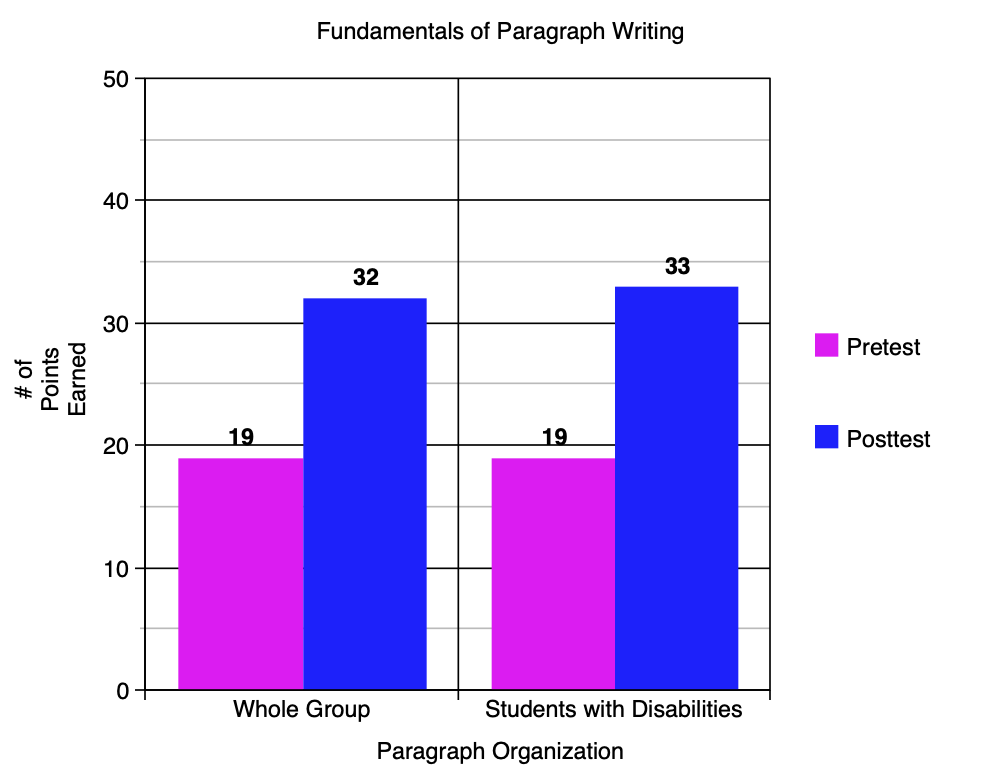
Again, these scores represent an improvement after the students had only one chance to write a practice paragraph before they took the posttest. The school year ended and further instruction and practice activities were not possible.
Jean B. Schumaker, Ph.D.
Whitney H. Miller, Ed.S.

Jean B. Schumaker, Ph.D.
Affiliations
My Background and Interests
I grew up with a concern for children who need special help. One of my earliest experiences was organizing birthday parties for children with disabilities at the Matheny Medical and Educational Center in New Jersey. After the birthday parties were over and all the decorations had been cleaned up, I spent additional time with those children, putting them to bed, reading to and talking with them, and singing to them. Through those experiences and others as a camp counselor, I found that I loved being with children and teaching them. Eventually, I decided that I wanted to be a clinical psychologist, and I went to college and graduate school with that goal in mind. However, along the way, I got hooked on doing research! In particular, I got hooked on research related to ensuring that children learn. I’ve worked with children in schools, camps, group homes, hospitals, and clinical settings. Across all those experiences, I’ve learned that all children can learn. I’ve learned that, if we hold high expectations for them and use special teaching methods, they usually meet those expectations. I continue to do research with the goal of helping teachers teach and students learn.
The Story Behind the Paragraph Writing Strategy Program
I started developing instructional programs for writing skills in the 1970s when I was a graduate student at the University of Kansas. My graduate program required me to take part in an internship at the probation department of the Douglas County Juvenile Court in Kansas. I was assigned several cases of truant secondary students. In working with these students, I learned that they could not write. They told me that one of the reasons they avoided school was that they were embarrassed because they could not complete the work assigned to them. I also learned that there were no instructional programs available to teach them writing in an intensive way. I embarked on a journey of developing writing programs that continues to this day.
Development of the Paragraph Writing Strategy Program started in the early 1980s. We originally thought that we could teach students to write topic sentences, detail sentences, and concluding sentences, and that, as a result, the students would be writing paragraphs that would be appropriate for secondary courses. We quickly learned that we could teach students how to write those types of sentences but that their paragraphs were horrifyingly simple. We also learned that there is a lot more to writing a “meaty” and well-organized paragraph than meets the eye. We realized, for example, that we needed to teach students basic concepts and associated skills such as how to use the same tense, the same point of view, and coordinated transitions throughout paragraphs and how to plan paragraphs. We also realized that students needed to learn how to write a variety of topic sentences, detail sentences, and concluding sentences. Karen Lyerla, a high school teacher, became my partner in creating the current program that contains a variety of learning sheets for each of the needed skills. Several years of trial and error were required before we had a program that worked. The program was finally published 10 years after the original idea for a paragraph writing strategy was hatched, but we are pleased that the program can be used to teach students to write excellent paragraphs.
Most recently, Whitney Miller became my partner in creating a paragraph writing program for elementary students. Again, the process required several years before we were happy with the results.
My Thoughts about Strategic Instruction
Strategic instruction is one of the few instructional methods that have been shown to be effective through empirical research to produce improvement in learning and in the academic performance of at-risk students. The studies conducted on the instructional program for the Paragraph Writing Strategy have shown students can learn to write well-organized paragraphs and can generalize their use of paragraph writing skills to their coursework when this program is used with fidelity. Instruction in the Paragraph Writing Strategy has been included in scope and sequence plans at the middle-school and high-school levels in numerous districts across the nation. The strategy has been taught in general education and special education settings to a wide variety of students.
Teacher and Student Feedback on the Paragraph Writing Strategy
Teachers often report that students ask them, “Why didn’t someone explain this to me in this way before?” They report that students are happy to learn how to plan and write well-organized paragraphs and pleased with the results that they can achieve in their required courses on writing assignments.
My Contact Information
Please contact me through Edge Enterprises, Inc.
(jschumaker@edgeenterprisesinc.com or 785-749-1473).
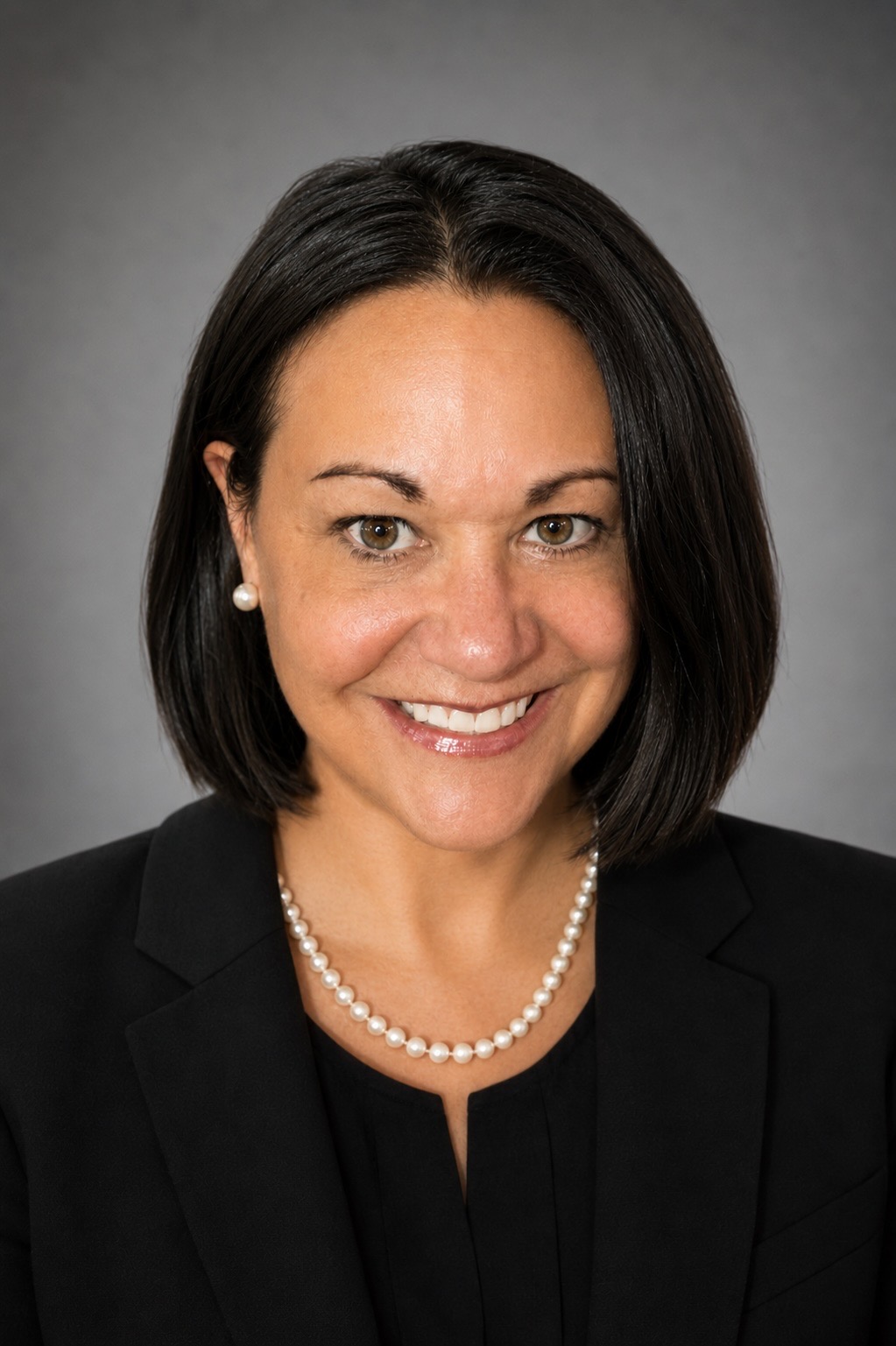
Whitney H. Miller, Ed.S.
Affiliations
Background and Education
Whitney Miller is a Coordinator of Instruction at the Virginia Department of Education’s Training and Technical Assistance Center (T/TAC) at Virginia Tech and serves as a Strategic Instruction Model (SIM™) Professional Development Leader. She earned a Master of Science degree in High Incidence Disabilities (K–12) from Radford University and an Education Specialist (Ed.S.) degree in Administration and Supervision from Virginia Tech.
Career
With more than 26 years of experience in public education, Whitney has dedicated her career to supporting and instructing students with disabilities across elementary and secondary school settings. Since joining T/TAC at Virginia Tech in July 2008, she has provided professional learning, technical assistance, and instructional support to educators across Virginia, with expertise in literacy, Specially Designed Instruction, and evidence-based instructional practices.
Publications
Whitney is a co-author of the peer-reviewed article, The Effects of a Comprehensive and Supplemental Middle School Reading Program, published in the International Journal of Research in Learning Disabilities (Brasseur-Hock, I. F., Miller, W., Washburn, J., Chroust, A. J., & Hock, M. F., 2021). Most recently, her contribution to the SIM™ Learning Strategies Curriculum is Fundamentals of Paragraph Writing, an instructional program developed to help elementary students build foundational writing skills.

 Fundamentals of Paraphrasing and Summarizing: Instructor’s Manual (eB...